


Mobile devices have changed significantly over the last two decades. A mobile phone that was once mainly used for voice calls and text messages has now become a small computing system that supports communication, entertainment, navigation, banking, remote work, and business applications. With every mobile generation, devices have gained new capabilities because networks improved and processing power increased. So, now let us look into How Mobile Devices May Evolve with 7G along with User-friendly LTE RF drive test tools in telecom & Cellular RF drive test equipment and User-friendly Wireless Survey Software Tools & Wifi site survey software tools in detail.
When 3G became common, mobile internet started becoming practical. With 4G, smartphones became stronger platforms for streaming, social media, cloud applications, and business workflows.
Now researchers are discussing concepts beyond 6G, commonly referred to as 7G. At present, 7G remains a research topic rather than a commercial technology. There are no standards or commercial deployments. Even so, research papers give useful ideas about how communication systems may evolve and what this may mean for future mobile devices.
One clear direction is that mobile devices may become far more intelligent than today.
At present, smartphones respond after a user gives a command. A person opens an application, starts navigation, launches a call, downloads a file, or performs a speed test. Future mobile systems may behave differently.
Instead of waiting for instructions, mobile devices may predict user behaviour and prepare actions automatically.
For example, a mobile device may recognize that a user normally joins a video meeting at a certain time and automatically prepare bandwidth, optimize audio settings, reduce background battery usage, and prioritize network resources.
Similarly, devices may learn travel habits and automatically adjust connectivity preferences depending on the surrounding environment.
This may sound simple, but the technical side behind this change is large. Researchers expect future devices to depend more heavily on local artificial intelligence processing. Rather than sending every task to the cloud, the device itself may process more information internally.
This means future smartphones may contain stronger AI processors designed for prediction, optimization, automation, and decision making.
Another likely change is how devices connect to networks.
Today, mobile phones depend mainly on terrestrial mobile towers along with Wi-Fi. If signal quality drops, users usually notice slower speeds, interruptions, or failed calls.
Future mobile systems may work differently.
Several research papers discussing future generations describe devices that move across different connectivity systems without interruption. Instead of relying only on nearby towers, devices may use a mix of:
• Mobile cellular networks
• Satellite systems
• Wi-Fi networks
• Private enterprise wireless networks
• Local edge systems
• Temporary aerial communication systems
In practical terms, a device may automatically select whichever system provides the best experience at that moment.
For example, a person travelling through rural areas may move between terrestrial coverage and satellite-supported connectivity without needing manual changes. A passenger on a ship or aircraft may experience better service continuity because devices could automatically adjust to available communication layers.
This type of change may improve reliability for industries where uninterrupted communication matters.
Another area expected to evolve is device hardware.
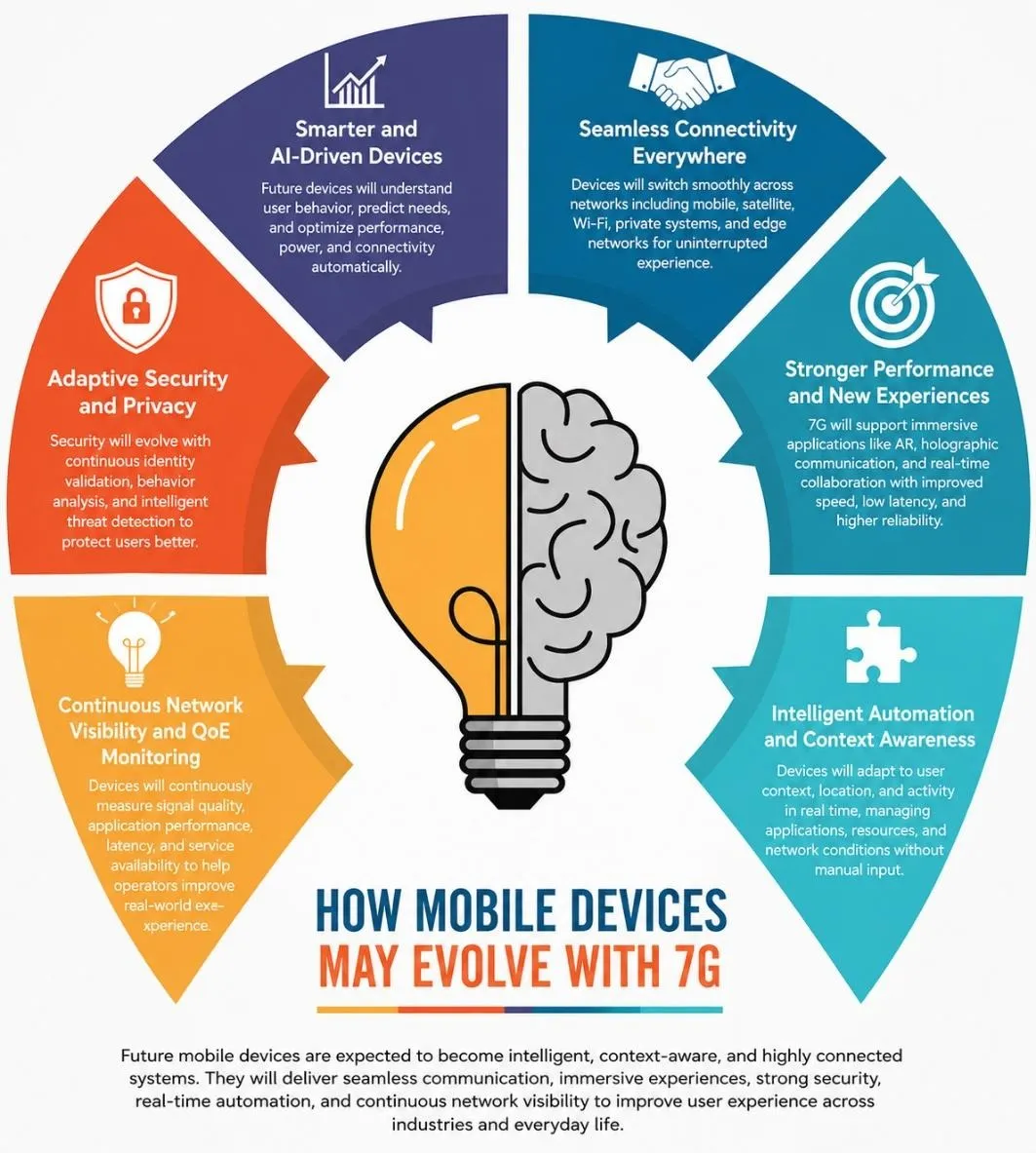
The infographic shows how mobile devices may become smarter, more connected, automated, and user-aware with 7G.
Every new generation of mobile communication has increased hardware demand. Faster networks lead to heavier applications. More demanding applications require stronger processors, larger memory, and better battery systems.
To support such workloads, mobile devices may need:
• Stronger processors
• Better heat management
• Faster memory systems
• Smarter power optimization
• Improved graphics performance
• Better radio support across many bands and communication systems
Battery technology may also improve.
One common complaint with modern smartphones is battery drain during heavy application use. Future devices may handle energy differently through smarter scheduling and AI-assisted power optimization.
For example, devices may automatically reduce background tasks, predict usage behaviour, and manage application resources more efficiently depending on time, movement, signal conditions, or user preference.
Charging methods may also improve with faster charging and better thermal control.
Security is another area likely to change.
Today, mobile security usually depends on passwords, biometrics, device encryption, and account verification systems.
Future devices may use continuous trust validation.
Rather than checking identity only once during login, devices may continuously monitor behaviour patterns.
For example:
• Typing behaviour
• Voice characteristics
• Movement patterns
• Location consistency
• Device handling patterns
• Usage habits
If unusual behaviour appears, the device may trigger additional verification automatically.
This approach may help reduce fraud, account misuse, and security threats.
| Category | Today’s Mobile Devices | Mobile Devices with 7G (Vision) |
| Connectivity | Cellular + Wi-Fi | Cellular + satellite + Wi-Fi + private networks + edge systems |
| Network Switching | Manual or signal-based switching | Automatic seamless switching across multiple networks |
| AI Role | Voice assistant and limited automation | AI-native prediction, optimization, and decision-making |
| Device Intelligence | User-driven actions | Context-aware and predictive behaviour |
| Performance | High-speed apps and streaming | Immersive apps, holographic communication, real-time collaboration |
| Latency Experience | Good for video, calls, browsing | Near real-time interaction and response |
| Battery Management | Manual settings and power-saving modes | AI-assisted smart battery and power optimization |
| Security | Passwords, biometrics, encryption | Continuous identity validation and intelligent threat detection |
| Network Monitoring | Periodic testing and troubleshooting | Continuous QoE, signal, latency, and app monitoring |
| Enterprise Usage | Communication and business apps | Industrial automation, logistics, aviation, smart operations |
| Device Types | Smartphones, tablets, wearables | Connected ecosystem of phones, wearables, smart glasses, vehicles |
| User Experience | Reactive and app-based | Intelligent, adaptive, and highly personalized |
| Main Goal | Fast communication and entertainment | Smart, automated, always-connected digital experience |
Another major change may happen in the way devices collect and process network quality information.
Today, network visibility often depends on manual testing, periodic measurements, troubleshooting, or customer complaints.
Future mobile devices may work as continuous quality measurement systems.
Instead of waiting for users to complain about poor performance, devices may constantly monitor:
• Signal quality
• Throughput performance
• Voice quality
• Application response time
• Video performance
• Mobility behaviour
• Service interruptions
This may help operators identify issues faster.
For example, if users in one region begin seeing unusual latency increases or failed voice sessions, network teams may receive visibility much earlier through automated measurements collected from devices.
This type of monitoring could improve customer experience because operators may fix problems before they affect larger groups of subscribers.
Enterprise and industrial use cases may also influence device evolution.
Today many enterprises already use smartphones and routers for logistics, worker communication, industrial monitoring, and field operations.
Future devices may support more automation for:
• Manufacturing systems
• Mining operations
• Aviation environments
• Shipping operations
• Smart transportation systems
• Remote infrastructure monitoring
In these situations, mobile devices may function less like consumer phones and more like intelligent service endpoints connected to automation platforms.
Another practical change may involve device form factor.
Smartphones may continue to exist, but future systems may also include wearables, glasses, industrial devices, smart sensors, vehicle-integrated systems, and portable computing systems connected to the same communication environment.
A user may shift tasks across devices without noticing service interruptions.
For example, a call started on a mobile phone may continue on smart glasses or vehicle systems automatically depending on context.
Even with all these expectations, one practical point should remain clear.
Many of these ideas are still research topics.
Some concepts discussed under 7G may arrive through 6G development instead. Some ideas may change completely depending on technical limitations, commercial demand, regulations, or device cost.
Still, research discussions provide a useful direction.
They suggest that future mobile devices may become smarter, more automated, more aware of surrounding conditions, and better connected across different communication systems.
The biggest change may not be only higher speed.
Future mobile devices may become systems that continuously understand user behaviour, network conditions, application needs, and service quality while making decisions automatically to improve the overall user experience.
About RantCell
RantCell helps operators, enterprises, regulators, and system integrators test, monitor, and benchmark mobile networks using smartphones and cloud analytics. From drive testing and indoor surveys to private 5G validation, QoE monitoring, and automated reporting, RantCell provides practical visibility into real-world network performance without requiring expensive hardware. Also read similar articles from here.