


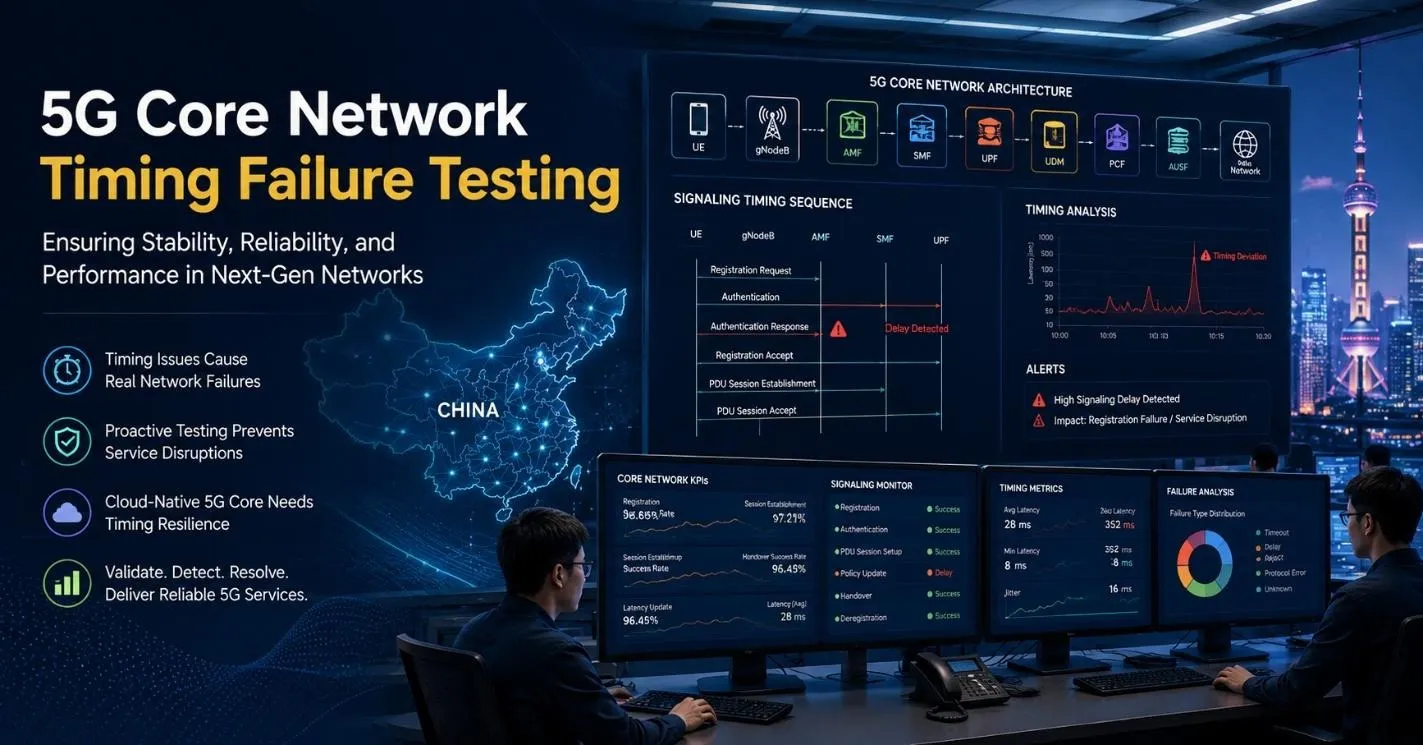
5G networks are changing the way mobile systems are designed and operated. Unlike older mobile generations where many network functions were tightly integrated, the 5G core is built using software-based network functions running across distributed cloud environments. This shift gives operators more flexibility, faster service deployment, and easier scaling. At the same time, it introduces a new operational challenge: timing-related failures between network functions. Recent work from researchers in China has highlighted a technical area that deserves more attention — timing failure testing in LTE and 5G core networks. So, now let us see Why 5G Core Network Timing Failure Testing Matters along with User-friendly LTE RF drive test tools in telecom & RF drive test software in telecom and User-friendly 4G Tester, 4G LTE Tester, 4G Network Tester and VOLTE Testing tools & Equipment in detail.
In simple terms, timing failure testing looks at what happens when two control-plane actions occur with a specific delay or timing sequence that the network software did not expect. A message may arrive too early, too late, or at a moment that creates an unstable interaction between network functions. Under certain conditions, this can lead to crashes, service interruption, failed registration, mobility problems, or session setup issues.
The 5G core depends heavily on interaction between many software components. Functions such as the AMF (Access and Mobility Management Function), SMF (Session Management Function), UPF (User Plane Function), AUSF (Authentication Server Function), UDM (Unified Data Management), and PCF (Policy Control Function) continuously exchange messages during subscriber registration, mobility management, authentication, handovers, and data session establishment. These functions communicate through APIs and service-based interfaces rather than fixed hardware links. This software-first design improves flexibility, but it also creates more chances for timing-sensitive issues to appear.
For example, consider a normal subscriber attach procedure in a 5G Standalone network. A user device attempts registration through the gNodeB, triggering a sequence of signaling exchanges between multiple core functions. Under ideal conditions, the messages are exchanged in the expected order and timing. But cloud-native networks are dynamic. Network functions may be distributed across data centers, workloads may move between servers, containers may restart, and orchestration systems may introduce slight delays. Even a small timing shift between messages can sometimes create an unexpected state inside a network function.
Traditional telecom testing methods mainly focus on protocol correctness, malformed inputs, interoperability, load testing, KPI verification, and standards compliance. Engineers normally verify whether signaling messages follow 3GPP procedures, whether throughput targets are met, or whether mobility scenarios behave correctly. Timing-induced failures are different because the problem is not always caused by incorrect signaling. The signaling itself may be technically valid. The issue appears because of the exact timing relationship between interactions.
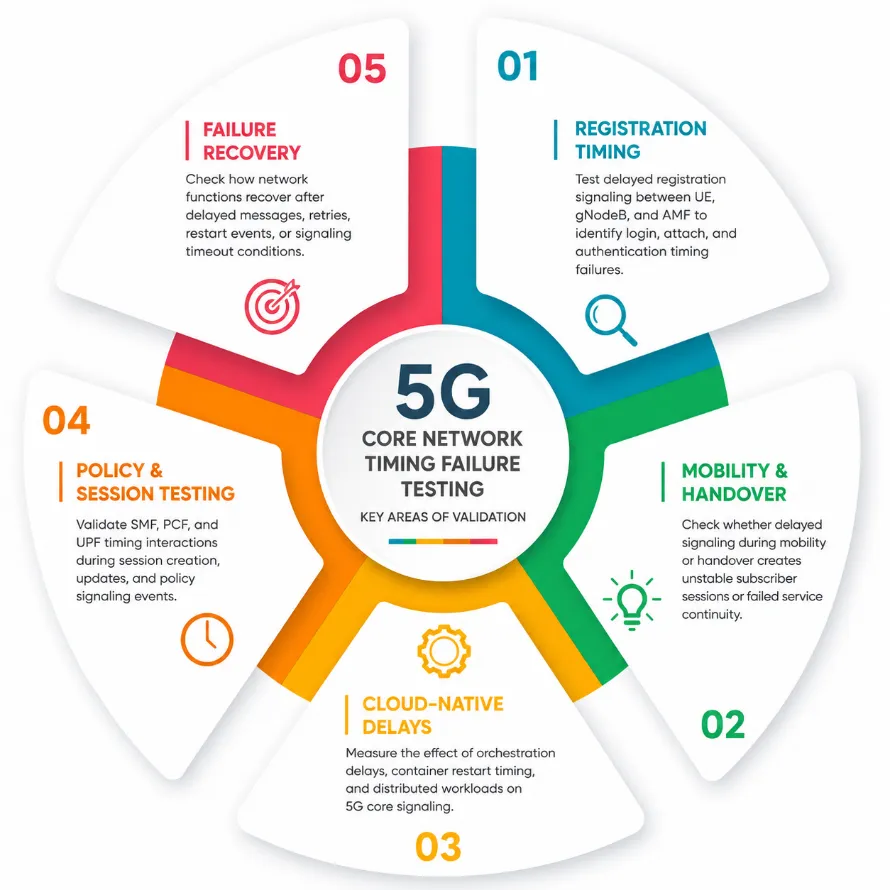
Researchers from China recently proposed a lightweight testing framework called Kairos to study this problem in LTE and 5G core networks. Instead of manually reading telecom standards and trying to predict possible timing problems, the framework tests interaction sequences automatically and studies failure behavior under different timing conditions. During evaluation, the researchers examined both open-source and commercial LTE and 5G core implementations and identified new vulnerabilities and previously known issues that could be reproduced through timing-sensitive interactions. Their results suggest that timing failures are more common than many operators or vendors may expect.
One of the practical concerns here is network reliability. A commercial mobile network handles millions of signaling transactions every day. Subscriber registration, handovers, voice setup, SMS signaling, policy updates, authentication requests, and session creation all depend on correct signaling coordination. If timing-sensitive failures remain hidden during testing, operators may discover them only after deployment when subscribers begin experiencing intermittent failures that are difficult to reproduce in the lab.
This issue becomes more relevant as operators move toward cloud-native 5G core deployments. Cloud-native architecture introduces orchestration systems, containers, Kubernetes-based management, dynamic scaling, and distributed deployment models. These systems improve deployment speed but also increase signaling interaction complexity. A network function may restart during operation, workloads may shift between compute environments, or network latency between services may temporarily change. Even if the protocol design is correct, timing-related interactions may behave differently in live conditions compared to lab conditions.
Large network scale makes reliability testing even more relevant because even a small failure rate may affect many subscribers. As operators expand enterprise services, industrial automation, smart manufacturing, and low-latency applications, control-plane stability becomes a direct service quality issue.
| Example 5G Core Timing Failure Testing Areas | ||||
| Testing Area | Network Function | Example Failure Scenario | What Engineers Test | Expected Outcome |
| Registration Timing | AMF / AUSF / UDM | Delayed authentication response | UE registration retry behaviour | Stable subscriber registration |
| Session Management | SMF / UPF | Delayed PDU session establishment | Session setup timing | Successful session creation |
| Mobility Signaling | AMF / SMF | Delayed handover signaling | Mobility stability | Session continuity maintained |
| Policy Interaction | PCF / SMF | Delayed policy update | QoS/policy consistency | Stable policy enforcement |
| Authentication Timing | AUSF / UDM | Authentication timeout | Retry logic and fail handling | Controlled recovery |
| Cloud Restart Scenario | AMF / SMF / UPF | Container restart delay | Service restoration timing | Graceful recovery |
| API Delay Testing | Service Interfaces | Delayed API message exchange | Control plane timing stability | No signaling failure |
| Retry Mechanism Testing | Multiple Functions | Multiple delayed responses | Retry handling behaviour | Stable recovery without crash |
| Latency Sensitivity Testing | Entire Core | Temporary timing shift | KPI and signaling validation | Controlled service continuity |
| Failure Recovery Testing | Core Functions | Timeout after delayed event | Recovery process validation | Minimal service impact |
From a telecom engineering perspective, timing failure testing should be treated as another layer of pre-deployment and post-upgrade validation. Operators already run interoperability testing, regression testing, stress testing, failover testing, and security checks. Timing-sensitive interaction testing can sit alongside these workflows to reduce unexpected signaling instability.
Several practical testing scenarios can be considered. Engineers may simulate registration retries with delayed authentication responses, delayed mobility signaling between AMF and SMF, repeated session setup attempts under temporary service interruption, or asynchronous policy updates. Test environments can intentionally introduce timing delays between interfaces to observe whether network functions recover gracefully or enter unstable states. Automation becomes useful because manual testing alone cannot easily cover the large number of timing combinations possible in a live 5G network.
Another useful lesson is that operators should not assume that passing standards testing automatically means operational stability. Protocol compliance confirms that a system follows expected procedures. Timing failure testing checks how stable that system remains when conditions become less predictable. In commercial mobile environments, unpredictability is normal. Network load changes, virtual infrastructure shifts, orchestration events, software upgrades, and transport delay variations happen regularly. Testing must reflect these conditions.
For vendors and telecom engineering teams, the message is straightforward. Timing-related failures in LTE and 5G core systems deserve more attention during validation. The move toward software-driven and distributed telecom networks increases the number of interactions between components, making timing behavior harder to predict. As 5G core deployments continue to expand, especially in large-scale environments such as China, timing failure testing may become a normal part of reliability engineering rather than a niche research topic.
About RantCell
RantCell is an Android-based mobile network testing and RF measurement platform designed for operators, enterprises, system integrators, regulators, and private network teams to perform real-world 4G and 5G testing using smartphones and tablets.
The platform supports drive testing, indoor walk testing, mobile benchmarking, QoE monitoring, throughput testing, KPI analysis, and cloud-based reporting workflows. Teams can measure KPIs such as RSRP, RSRQ, SINR, PCI, EARFCN/NRARFCN, throughput, latency, call performance, and service quality across real network conditions.
RantCell also supports cloud upload, automated PDF reporting, dashboard analytics, indoor floor plan testing, private LTE/5G validation, and advanced Pro Plus workflows including Layer 2/Layer 3 measurements, band locking, and engineering-level troubleshooting on supported rooted Android devices. Also read more articles from here.